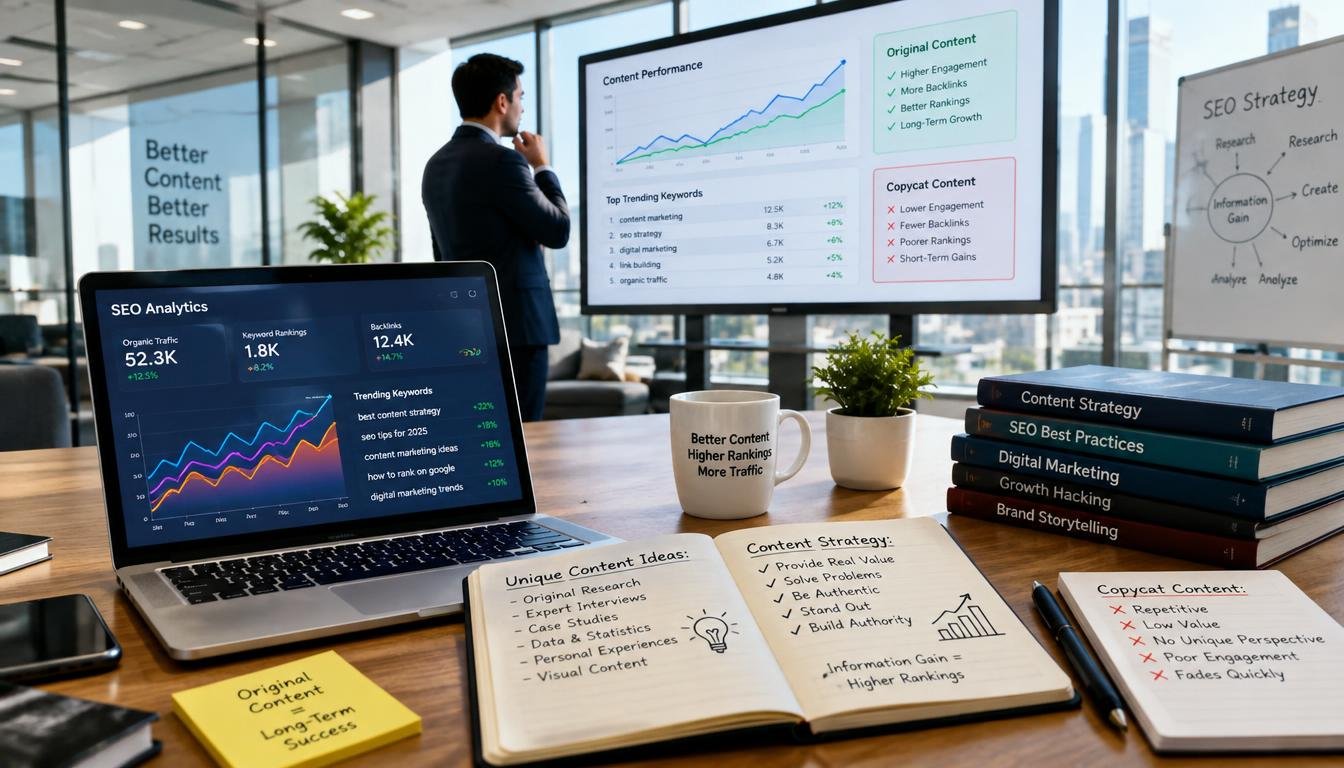
At BrightonSEO 2025, I heard one phrase in nearly every session: information gain. Speakers called it the new metric for what AI systems cite, not only what ranks on page one.
That stayed with me because I had just run an experiment. My articles kept losing ground to pages with nothing new, so I tested a different approach on my own site.
Most content teams face a simple problem: they republish facts already found in the top ten results. Google and AI models now spot this sameness quickly, then skip those pages.
This information gain SEO guide explains what works: the definition, duplicate content’s limits, and what Google confirms or leaves uncertain. You will learn competitor gap audits, seven tactics, a before-and-after case, and a ready-to-use content brief. It also covers E-E-A-T, measurement methods, and whether artificial intelligence tools can help create truly original work.
Treat this as a field-tested playbook based on real testing, not theory.
Key Takeaways
- Copycat content that repeats top-ranking facts is losing visibility in both Google search and AI-generated answers.
- Consistency and strategic planning matter more than publishing volume when it comes to earning lasting search results.
- BrightonSEO 2025 highlighted a clear shift: AI systems now favor content that adds something new over content that just repeats.
- Auditing competitor pages for gaps is the starting point for creating content worth citing.
- Practical, field-tested tactics beat theoretical advice when you’re building a content strategy that actually stands out.
- E-E-A-T and measurable originality are closely connected to long-term ranking success.
1. What Information Gain Really Means in SEO
Ask ten SEOs what information gain SEO means, and you will probably get ten different answers. I read technical explanations, sat through webinars, and still found most definitions too bloated to use in practice. So I built my own: short enough to remember and specific enough to guide every piece I write.
My 50-Word Definition of Information Gain
Here is my exact definition, trimmed to 50 words on purpose:
Information gain means publishing content that adds genuinely new, useful knowledge beyond what’s already ranking on page one. It’s not rewording the same five points in different order. It’s original data, hands-on testing, or expert insight that doesn’t exist anywhere else — the reason readers and AI choose your page.
That’s it. No fluff or jargon. Every article must clear this bar before I publish.
Why It Affects Both Rankings and AI Citations
A few years ago, ranking meant matching keywords and stacking backlinks. That playbook is fading fast.
Search engines and AI assistants now reward unique information value over repetition. If your page repeats the other nine results, no algorithm or human has a reason to choose yours.
BrightonSEO frames it this way:
Information gain – how much new, useful knowledge your content adds beyond what already exists – is fast becoming the metric that determines what gets cited.
This now goes beyond organic rankings. The same gaps can leave a page on page two and a brand invisible in AI-generated answers. Information gain SEO now serves as the shared requirement for both.
2. Why Copycat Content Keeps Losing to Original Pages
I once opened ten browser tabs to research one question. By the fifth tab, I felt I was reading the same article again.
Same statistics, bullet points, and generic advice appeared in slightly different words. Then I realized most online content does not compete; it copies.
The Sameness Problem I Kept Running Into
I call this the sameness problem, and once I noticed it, I could not ignore it.
Page after page covered the same five points in the same order. No one added a new data point, a fresh test, or even a different opinion. It all blurred together, and I suspect search engines and AI models see the same blur.
That is why a smart content optimization strategy must include something no other page offers. Better formatting and longer word counts will not cut it anymore.
What Happens When Ten Pages Say the Exact Same Thing
When ten pages repeat the same facts, none has a clear reason to rank above the others. Search systems and AI assistants may choose almost arbitrarily because nothing sets one page apart.
Paris Childress put this better than I could at BrightonSEO:
“AI mostly feeds at the trough of AI slop, and it’s happy to do so. But we can all do much better. What it wants is truffles — something exceptional that is useful. AI is really a truffle hunter.”
That image stayed with me. Most content is slop, while Google and AI tools actively hunt for rare pages that taste different.
StrategiQ summed up what this means for everyone: “Unique content is the new visibility currency.” I believe it, and every audit I run proves it more.
3. The Google Information Gain Patent and What Google Has Actually Said
I trace each SEO concept to its source before I trust it. This one leads to a patent filing. The google information gain patent appears often in SEO discussions, sometimes with more confidence than evidence supports. I’ll explain the patent, then separate it from Google’s public statements.
What the Patent Describes, and Why I'm Careful Not to Overstate It
The patent was filed in 2018. It describes a scoring method that compares a new document with pages Google considers relevant to a search query.
The goal seems simple. Google wants to estimate how much new information a document adds to existing search results.
A page that repeats current results scores low on this measure. A page with new facts, data, or angles scores higher.
“The information gain concept is rooted in a Google patent from 2018 that scores how much new and useful information a piece of content adds beyond what already exists.”
Here’s where I stay careful. A patent filing does not prove Google uses this exact system in live rankings today.
Companies patent ideas they never release or change years later. I see this patent as a strong clue about Google’s thinking, not a confirmed ranking system.
Public Statements From Google I Trust More Than Speculation
I trust Google’s public comments more than patent interpretations. Patents describe possibilities, while spokespeople describe current priorities.
Google representatives have repeatedly said they want to reward content offering:
- Unique value readers can’t find anywhere else
- Firsthand expertise from someone who actually did the work
- Genuine insight that goes beyond summarizing other sources
These statements match the patent’s ideas without confirming its exact scoring formula. That consistency matters more than any single technical detail.
Whatever mechanism Google uses today, the pattern remains consistent. Content that adds something new often performs better over time, while repeated top 10 results can fade into page two.
4. How I Audit the Top 10 Results to Find Content Gaps
Before writing, I spend an hour examining the ten pages ranking for my target keyword.
This isn’t guesswork. I use this repeatable process for almost every article, and it shows what the search engine ranking factors are rewarding now. The goal is simple: learn what’s been said, so I never repeat it.
Step 1: Mapping What Every Top Result Already Covers
I open all ten ranking pages side by side and build a simple spreadsheet. Each row lists a subtopic, a stat, or an angle, and each column shows whether a page covers it.
Within minutes, a pattern appears. I call it the “shared skeleton”—the handful of points every page repeats almost word for word. This is the content I must avoid copying because it already fills the results.
Step 2: Spotting Outdated Numbers and Missing Angles
Next, I review that skeleton for cracks. Stats from two or three years ago appear as current, hurting document relevance scoring because search engines favor fresh data.
I also check “People Also Ask” boxes and Reddit threads for questions that top 10 pages leave unanswered. These gaps often show real searcher intent going unmet.
Watching where a topic is gaining traction on Reddit or YouTube before it shows up in keyword tools gives you a head start most competitors never get.
This is where I borrow a technique from Frank van Dijk’s BrightonSEO talk about finding emerging topics. He tracks mention velocity on Reddit and YouTube to find angles gaining momentum before search volume data records them. I’ve started doing the same, and it has found trends weeks before competitors noticed them.
Step 3: Turning Gaps Into a Content Opportunity List
The last step turns research into action. I don’t write vague notes like “add more detail.” I write specific instructions for a content brief.
| Gap Type | Example Finding | Specific Action Item |
|---|---|---|
| Outdated Stat | Pricing data from 2022 still cited | Include verified 2025 pricing data |
| Missing Angle | No page addresses small business use case | Add a counterpoint on why the advice fails for small businesses |
| Weak Evidence | Claims lack proof or examples | Add a screenshot or case study with real numbers |
| Emerging Trend | Rising Reddit mentions, low search volume | Cover the trend early with an original explainer |
This process turns a few hours of research into a sharp, specific plan. It’s the difference between writing another page that blends into the top 10 and writing one that truly stands apart.
5. 7 Ways to Add Real Information Gain SEO to Your Content
Finding a content gap is easier than filling it with information no competitor has published. Over the years, I built a short list of methods that work. Each method supports a broader content optimization strategy instead of acting as a one-time trick.
Here are seven tactics I use often, with real examples from my work.
1. First-Party Data From My Own Audience or Product
Most businesses already have the information gain they need. They simply have not searched for it yet.
“The truffles are already inside your business.”
Sales calls, support tickets, and internal Slack threads reveal patterns outside bloggers cannot see. I pull numbers from my audience surveys or product dashboards instead of quoting someone else’s study. Last month, a quick newsletter poll produced a statistic no competitor could copy.
2. Original Tests and Experiments I Ran Myself
“Best practices” lose value when nobody has checked them recently. I run small experiments instead of repeating advice I have not tested.
For example, I tested a new internal linking tactic for two weeks and reported the exact traffic change. That data made my article more useful than five articles repeating generic advice.
3. Expert Quotes That Add Authority I Don't Have Alone
Sometimes, I lack the experience a topic deserves. Then I contact someone who has that expertise.
“The strongest answer pairs proprietary data with a named expert.”
A short quote from a named practitioner can separate my page from many copycats. AI summaries often favor this pairing because it signals a verified source behind the claim.
4. Screenshots That Prove I Actually Did the Thing
Words alone cannot prove that I tested something. A screenshot can.
Dashboard views, before-and-after UI changes, and real search result pages provide visual proof. These images are clear seo content quality signals because they show the work, not just the description.
5. Case Studies With Real Numbers and Names
Vague stories like “a client of ours” rarely convince people. Specific numbers and real company names do.
“Measure what hasn’t yet been measured… journalists love exclusive data.”
When a client agrees to be named, I always ask. A permitted case study is easier to cite than a generic success story. Other sites often share it and link to the original source.
6. Supported Contrarian Angles That Challenge the Consensus
Challenging popular advice works only when I can support it. I find outdated or oversimplified guidance, then build a reasoned counterargument with evidence.
This is not about seeking attention. It is about stating a truth that most pages are too cautious to admit.
7. Updated Numbers When Everyone Else Is Citing Old Stats
This final method is the easiest win on the list. I check whether competitors cite statistics from three years ago, then use the current year’s data.
It takes less effort than an original study, yet it closes a real content gap. This habit has improved more rankings than almost anything else in my content optimization strategy.
| Method | Effort Required | SEO Payoff |
|---|---|---|
| First-Party Data | Low to Medium | Unique stats competitors can’t replicate |
| Original Tests | Medium | Verified results that build trust |
| Expert Quotes | Low | Added authority and citation potential |
| Case Studies | Medium to High | Strong backlinks and media pickup |
| Updated Numbers | Low | Fast wins over outdated competitors |
6. Before-and-After: A Weak Section vs. a Strong One
The fastest way to understand unique information value is to watch it enter a flat, forgettable paragraph. I chose a topic found in nearly every “best running shoes” roundup and rewrote it twice. The first version copies ten ranking pages; the second uses two methods from the last section.

The Weak Version Most Pages Publish
Here’s the kind of paragraph I see over and over:
“Running shoes with good cushioning can help reduce impact on your joints. Many runners find that a supportive shoe makes long runs more comfortable. It’s important to choose a shoe that fits your foot type.”
This paragraph could appear on any of the ten pages I audited. It makes no specific claim, cites no source, and proves nothing. Readers leave knowing exactly what they knew before clicking.
The Strong Version After Adding Information Gain
Now compare it with my rewrite, which uses a first-party test and an expert quote:
“I ran 50 miles in the Hoka Clifton 9 and tracked joint soreness on a 1-10 scale after every run. My average score dropped from 6.2 in my old shoes to 3.1 by week two. Dr. Sarah Chen, a sports podiatrist I interviewed for this piece, confirmed that a 4mm heel-to-toe drop like this model’s ‘reduces load on the Achilles for most mid-foot strikers.'”
Two additions created the unique information value the weak version lacked: my test’s number and a named expert’s explanation. Nobody else can publish those exact sentences.
Run this same check on your published pages. If a paragraph could slide into a competitor’s article unnoticed, rewrite it this way.
7. My Repeatable Content Brief Template for Information Gain
Every article I write now begins with the same one-page document, long before I write any copy. It uses findings from the top 10 audit and turns them into a clear plan with required fields.
This brief turns research into a content optimization strategy I can execute, rather than unused notes.
The Fields I Fill In Before Writing a Word
My template has five fields. Skipping one can leave an article thin, even when the writing is strong.
- Top 10 gap summary: what every ranking page already covers, pulled straight from my audit.
- Chosen information gain method: which of the seven approaches I’m using, whether it’s original data, a test I ran, or an expert quote.
- Source of the unique input: the exact dataset, interview, or tool output I’ll pull from.
- Required proof elements: screenshots, named sources, or updated statistics that must appear in the final draft.
- The one-line addition statement: a single sentence answering what this page adds that nothing else does.
The final field gets the closest review. If I cannot answer it honestly, I research more before anyone starts drafting.
I borrowed part of this structure from Christian Rigg’s BrightonSEO talk about building a thought leadership system. His process gathers expertise from sales calls, meeting transcripts, internal tools, and expert interviews into one knowledge base. Without that infrastructure, I save call and Slack quotes in a spreadsheet as they happen, ready for future briefs.
How This Template Keeps Every Article Consistent
Using the same five fields for every article keeps quality steady, even when my motivation changes.
Information gain is no longer a one-off tactic for one flagship post. It is now a standard in my content optimization strategy. I repeat it across every calendar item, from quick blog updates to full-length guides.
“A brief without proof is just an outline with extra steps.”
That line sits at the top of my template file as a reminder. It keeps me honest before the writing begins.
8. How Information Gain Connects to E-E-A-T
Information gain and E-E-A-T are not competing frameworks; they use the same raw material. Firsthand experience and real expertise create content that offers something new, instead of repeating what already ranks.
I once saw these as two separate SEO content quality signals. Now, I see one system reinforcing itself.
Experience and Expertise as Information Gain Signals
Real experience creates information gain because you notice details that a generic writer would miss. At BrightonSEO, Katie Mishner said empathy is an overlooked part of E-E-A-T that AI cannot truly replicate.
Knowing what readers fear or need changes what you choose to cover. That emotional accuracy often reveals the exact angle competitor pages miss.
Trust Signals That Help AI Summaries Cite You
AI summaries do not only pull information; they also pull credibility. Sophie Winkels described trust-building through named authors with real, checkable credentials and clear notes showing when content was updated.
Sarah McDowell added another layer: podcasting builds compounding E-E-A-T signals over time. It creates backlinks, author authority, and demonstrated expertise that is hard to fake.
These trust signals show that unique information is credible, not merely different. E-E-A-T is not a separate checklist beside information gain. It adds credibility, making original research actually worth citing.
9. Measuring Information Gain Without Guessing
“How do I know this works?” After adding original data or expert quotes, people often ask me that question. Do not guess; track a few signals over time.
Semantic and Document Relevance Scoring, Explained Simply
Semantic relevance scoring sounds technical, but its basic idea is easy to understand. Tools using information retrieval algorithms compare your page’s words and topics with pages ranking for that query.
Document relevance scoring works similarly, but it focuses on one page, not the entire competition. Both ideas draw on decades of academic information retrieval research, the same science behind modern search engines.
I do not know Google’s exact internal formula, and neither does anyone else. Still, these scores give me a useful direction. They show whether my page repeats existing content or adds something genuinely new.
Content Freshness Metrics and Other Signals I Track
Alongside semantic scoring, I track a short list of practical content freshness metrics. I compare update frequency with competitors, check cited statistics, and review traffic trends after each refresh.
One signal I now watch closely is AI citation share. At BrightonSEO, Paris Childress made a point that stayed with me:
“Run case studies with measurable lifts in AI citation share.”
That idea guides my work now. After an information-gain-focused update, I check whether my brand starts appearing in AI-generated answers where it did not show before.
You do not need a data science background for this work. Just compare your numbers before and after, stay consistent, and let the pattern show what works.
10. Is Information Gain an Official Google Ranking Factor?
Here is the straight answer: Google has never officially named information gain a standalone factor among search engine ranking factors.
That may disappoint after everything I’ve shared about the patent and Google’s own comments, but it is true. A patent is not a confirmed live ranking signal. It is a documented idea that a company has the legal right to use. Google has many patents that may never affect a single search result.
What we do have is a pile of circumstantial evidence. There is a patent describing a scoring method for unique content. There are years of public statements from Google employees praising original insight, firsthand experience, and unique value.
None of this equals an official announcement, such as Google’s confirmation of page experience as a ranking signal.
My honest take: information gain is probably influential in some form, but it is not a confirmed, isolated ranking factor. Treating it as directionally important, rather than a literal box to tick, works better for me. Official confirmation may never come.
The official status matters less than you might think. Content with real information gain stands out from competitors, earns citations in AI summaries, and builds reader trust. These wins happen whether or not Google ever uses that exact phrase in a ranking announcement.
| Signal Type | Officially Confirmed? | What Google Has Said |
|---|---|---|
| Page Experience | Yes | Named directly in Google’s documentation as a ranking signal |
| Core Web Vitals | Yes | Published metrics with explicit ranking impact |
| Information Gain | No | Patent exists; public comments favor unique value, not a named factor |
| E-E-A-T | No | Described as a quality framework, not a direct ranking factor |
11. Can AI Help Create Information Gain?
Clients and readers often ask whether AI can create information gain. My honest answer is yes and no.
AI speeds up boring research, including work with information retrieval algorithms. It cannot replace original thinking, testing, or real-world proof that makes content stand out.
Where AI Speeds Up My Research
I use AI to summarize the top 10 competitor pages in minutes, not hours. It organizes audit spreadsheets and turns messy information retrieval algorithms output into clear gap lists faster than I could by hand.
That speed matters more than many people realize. A roundtable discussion at BrightonSEO captured this shift well:
“AI has made the basic SEO audit table stakes.”
Because everyone now has access to fast audits, the real advantage comes from strategic prioritization and sharp commercial judgment. I redirect the time I save on repetitive research toward original thinking that creates information gain.
Where AI Still Can't Replace Original Work
AI cannot run my product experiments. It cannot generate a real first-party survey result or an authentic quote from a working expert. It cannot create a screenshot proving I completed the task.
Those pieces still require me. AI accelerates research and drafting, but it cannot replace lived experience or original data. Those elements separate my content from everyone else’s.
| Task | Can AI Handle It? | Why or Why Not |
|---|---|---|
| Summarizing competitor pages | Yes | Pattern recognition across existing public text is fast and accurate |
| Structuring gap lists from data | Yes | Organizing information retrieval algorithms output into readable formats is repetitive work |
| Running an original product test | No | Requires real access, real users, and real measurement I control |
| Collecting an expert quote | No | Needs a genuine human conversation with someone who has true authority |
12. Conclusion
After months of testing this approach on my own site, I learned the biggest shift was not one clever trick. It was a change in mindset. I stopped asking what the top 10 pages say and started asking what I know that they do not.
That question changes how I write. Information gain seo is not about adding more words to a page. It adds something no one else included: a real test, a sharper number, or honest opinion backed by proof.
Nathan from StrategiQ said it best at BrightonSEO: unique content is becoming the new visibility currency.
The brands winning now layer genuine expertise on top of it. They own a topic through perspective instead of showing up with more pages.
Please do not rebuild your whole content library this week. Pick one method from the seven I shared earlier. Add a real data point, a screenshot, or a quote from someone who knows the subject.
Apply it to one page you already published. See what happens. Then repeat the process.
FAQ
What is information gain in SEO, in plain language?
In my words, information gain adds genuinely new, useful knowledge beyond content already ranking. It goes beyond summarizing the top 10 by contributing something nobody else has said. This is the heart of any real content optimization strategy today, not merely an extra.
Why does information gain matter more now than it used to?
AI-powered search results and chat assistants increasingly choose sources for unique information value, not keywords or backlinks. This shift affects organic rankings and AI citation share. The old “write 2,000 words that sound like page one” playbook fails.
What is “the sameness problem” you mentioned?
I noticed it after reading ten competing pages on one topic: same stats, structure, and generic advice, simply reordered. Paris Childress’s “truffle hunter” metaphor stayed with me. Most content is AI slop, while search engines and AI assistants hunt for rare pages that add something real.
Is the Google information gain patent proof that Google uses this system?
No, and I want to be careful here. The 2018 patent describes scoring a document against other relevant documents, estimating its new information. A patent does not prove production use. I trust Google’s public statements on unique value and expertise more than patent speculation about search engine ranking factors.
How do you audit competitors to find content gaps?
First, I map each top 10 page’s subtopics, stats, and angles in a spreadsheet to reveal the “shared skeleton.” Second, I find outdated numbers, missing People Also Ask angles, and generic advice; Frank van Dijk watches Reddit and YouTube trends. Third, I turn every gap into a clear brief line, such as “include 2025 pricing data,” instead of vague notes.
What are some practical ways to actually add information gain to a page?
I use first-party data, original tests, expert quotes, screenshots, case studies with real numbers, supported contrarian angles, and updated statistics. Christian Rigg calls sales calls and support tickets untapped goldmines, while Jessica Hulbert favors proprietary data plus a named expert. Madeleine Lambert says to “measure the unmeasured,” and these seven methods support my seo content quality signals checklist.
Can you show an example of weak versus strong information gain?
A weak paragraph makes a vague claim without numbers or attribution. It could appear on any of ten competing pages. A strong version adds first-party data, a named expert quote, or an original test result, creating unique information value.
What does your content brief template look like?
Before writing, I summarize top 10 gaps, choose among seven methods, and name each unique data or expert-quote source. I list proof, such as screenshots or named sources, and write what this page adds that nothing else does. I adapted Christian Rigg’s sales-call and Slack-thread idea for smaller teams without that infrastructure.
How does information gain connect to E-E-A-T?
Firsthand experience and real expertise create non-copycat content, so they strengthen each other. Katie Mishner says empathy is part of E-E-A-T, and AI cannot truly fake it. Named authors with checkable credentials, as Sophie Winkels describes, and Sarah McDowell’s podcasting approach can build authority and support AI citations.
How do you measure whether information gain efforts are working?
I use tools and habits rooted in information retrieval algorithms. Semantic relevance scoring and document relevance scoring compare vocabulary, topic coverage, existing rankings, and new ground. I track content freshness metrics, including updates versus competitors, and watch AI citation share after updates, as Paris Childress described.
Is information gain an official Google ranking factor?
Honestly, no. Google has not confirmed it as a named, standalone factor like page experience signals. There is a patent and years of statements about unique value and firsthand expertise. My view: it probably influences search, but treat it as directionally important, not a literal checkbox.
Can AI help create information gain, or does it defeat the purpose?
AI speeds my research by summarizing top 10 pages, organizing audit spreadsheets, and structuring gap lists. This echoes the BrightonSEO roundtable’s view that basic audits are now table stakes. AI cannot run experiments, create surveys, produce expert quotes, or take proof screenshots; it accelerates research, not original data.