Quick Read: OpenAI Instant Checkout Explained
What You’ll Learn:
- How OpenAI’s Instant Checkout transforms the entire e-commerce buying journey
- The Agentic Commerce Protocol explained in plain English
- ChatGPT ads timeline and revenue opportunities for 2026-2029
- Actionable implementation strategies for businesses of all sizes
Why It Matters Now: The shift from “search and click” to “chat and buy” is happening faster than most businesses realize. Early adopters are positioning themselves for unprecedented competitive advantages.
Key Stats:
- 80-85% faster checkout times compared to traditional e-commerce
- ~50% reduction in cart abandonment rates (projected)
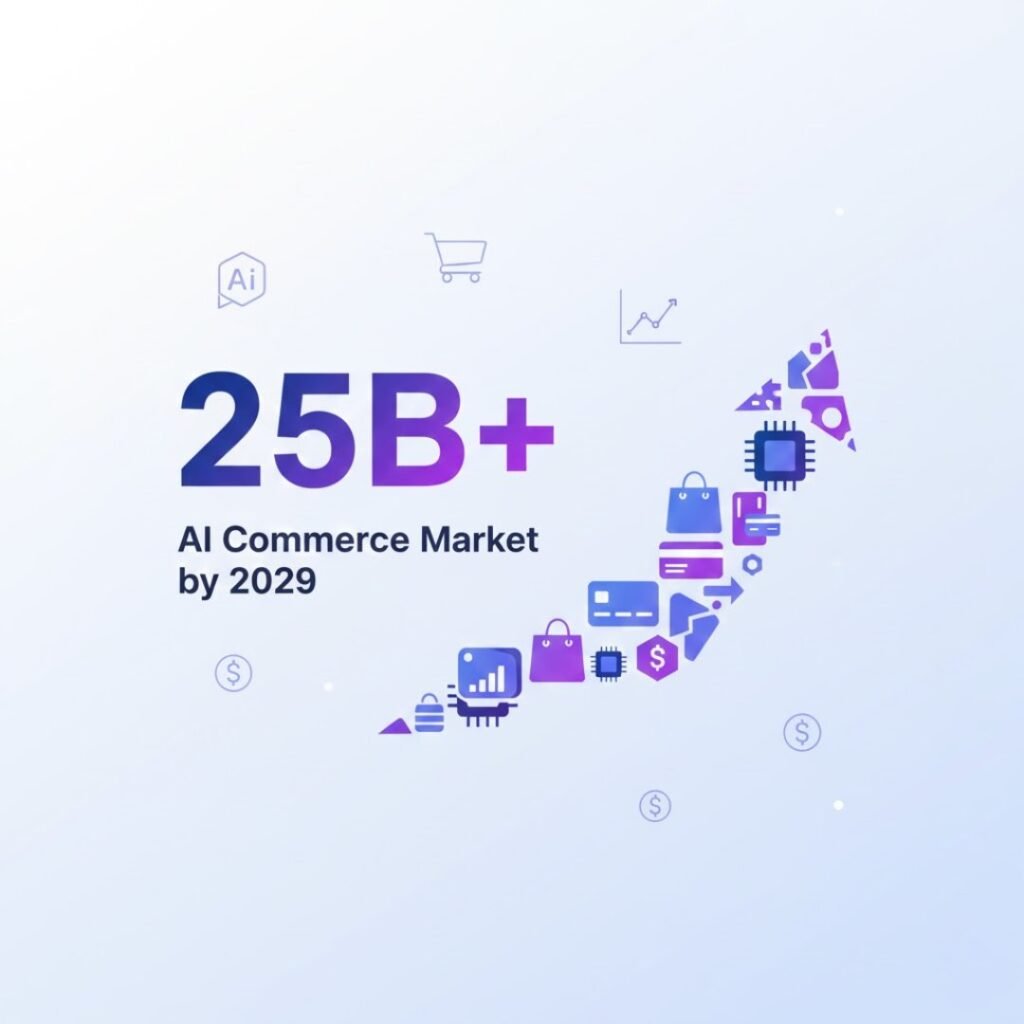
- $25 billion+ OpenAI revenue target by 2029
- 2026 expected launch of ChatGPT advertising platform
Reading Time: 12 minutes
Best For: E-commerce owners, digital marketers, business strategists, online retailers
Automate Content Creation is my pick for a practical plan to cut research and production time for code-heavy posts without losing accuracy.
I’ll define scope and show how the right mix of strategy and tools maps to the writing process. You’ll see a clear plan from keyword discovery to publishing and iteration for each blog post.
I use industry data to set expectations: 98% of marketers rate automation as very or extremely important, first-time users see about 20% more productivity, and ROI often hits $6.66 per $1 invested. I’ll explain partial versus full automation and when you must keep a human in the loop for code validity and citations.
Quick personal tip: batch outlines for how-to and troubleshooting posts, then verify every code snippet before publishing to scale reliably.
Disclosure: BBWebTools.com is a free online platform that provides valuable content and comparison services. As an Amazon Associate, we earn from qualifying purchases. To keep this resource free, we may also earn advertising compensation or affiliate marketing commissions from the partners featured in this blog.
🎯 Key Takeaways
- The Shift Is Real and Accelerating: Conversational commerce isn’t speculative future-tech. It’s happening now, with measurable business impact. Early-adopter merchants are seeing 150-230% improvements in conversion rates and a ~50% reduction in cart abandonment.
- Early Adoption Creates Lasting Advantage: The 2026-2027 window offers disproportionate benefits: lower advertising costs, less competition, platform partnership opportunities, and customer acquisition before markets saturate.
- Technical Implementation Is Accessible: If you’re on modern e-commerce platforms (Shopify, WooCommerce, BigCommerce), integration is straightforward with existing plugins. Custom platforms require more effort, but nothing insurmountable.
- Product Optimization Matters More Than Ever: GEO (Generative Engine Optimization) for ChatGPT requires clear, attribute-rich product information. Keyword-stuffed descriptions won’t cut it.
- ChatGPT Ads Will Be Transformational: When advertising launches in 2026, it will offer targeting precision and conversion rates that exceed current platforms—at least initially. Budget allocation should shift accordingly.
- Multi-Platform Strategy Is Essential: ChatGPT complements rather than replaces Amazon, Google, and direct e-commerce. Success requires optimization across all channels where your customers shop.
- Customer Experience Drives Adoption: Customers who experience conversational commerce overwhelmingly prefer it for certain shopping tasks. This isn’t a novelty—it’s a better way to shop.
📘Introduction: The Dawn of Conversational Commerce
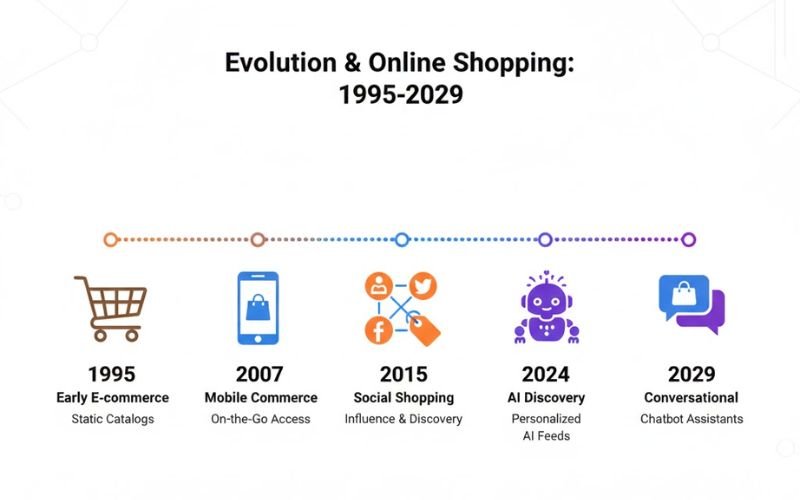
Remember when Amazon’s “1-Click” ordering felt revolutionary? That was 1997. Now, we’re witnessing something far more transformative: the ability for customers to discover, evaluate, and purchase products through natural conversation—without ever visiting a website.
In December 2024, OpenAI quietly launched a solution that fundamentally reshaped online shopping: Instant Checkout, powered by the Agentic Commerce Protocol. This isn’t just another payment widget or checkout optimization tool. It’s the beginning of a paradigm shift where AI shopping assistants like ChatGPT become primary commerce channels, not just discovery tools.
As someone who’s navigated three decades of digital marketing evolution—from the early days of banner ads to the rise of social commerce—I can tell you this moment feels different. We’re not talking about incremental improvements to conversion rates. We’re witnessing the emergence of an entirely new buying behavior that will define the next decade of e-commerce.
Here’s what makes this particularly exciting: this technology levels the playing field. Small and medium-sized businesses can now compete with retail giants on customer experience, personalization, and conversion efficiency—all without massive technology investments.
In this comprehensive guide, we’ll explore:
- What OpenAI Instant Checkout actually is and how it works
- The measurable impact on your e-commerce business metrics
- How customer experience transforms in the ChatGPT shopping era
- Practical implementation steps you can take today
- The coming ChatGPT ads revolution and $25B opportunity
- Strategic positioning for 2026-2029 and beyond
Whether you’re running a Shopify store, managing a WooCommerce site, or operating an enterprise e-commerce platform, understanding this shift isn’t optional—it’s essential for survival in the AI commerce era.
Let’s dive in. 🚀
What Is OpenAI Instant Checkout?
https://youtu.be/C6qcZdtIv54?si=eY_hID-YepbMekEW
Understanding the Agentic Commerce Protocol Revolution
At its core, OpenAI Instant Checkout is a seamless payment and fulfillment system that enables customers to complete purchases directly within ChatGPT conversations—without leaving the chat interface or navigating to external websites.
Think of it as the natural evolution of conversational AI meeting frictionless commerce. A customer can say, “I need running shoes for flat feet, size 10, under $120,” and ChatGPT not only recommends products but also completes the purchase in seconds—all within the same conversation.
The magic happens through OpenAI’s Agentic Commerce Protocol, a sophisticated API framework that connects ChatGPT to merchant inventory systems, payment processors, and fulfillment networks in real-time.
How the Technology Works: Step-by-Step
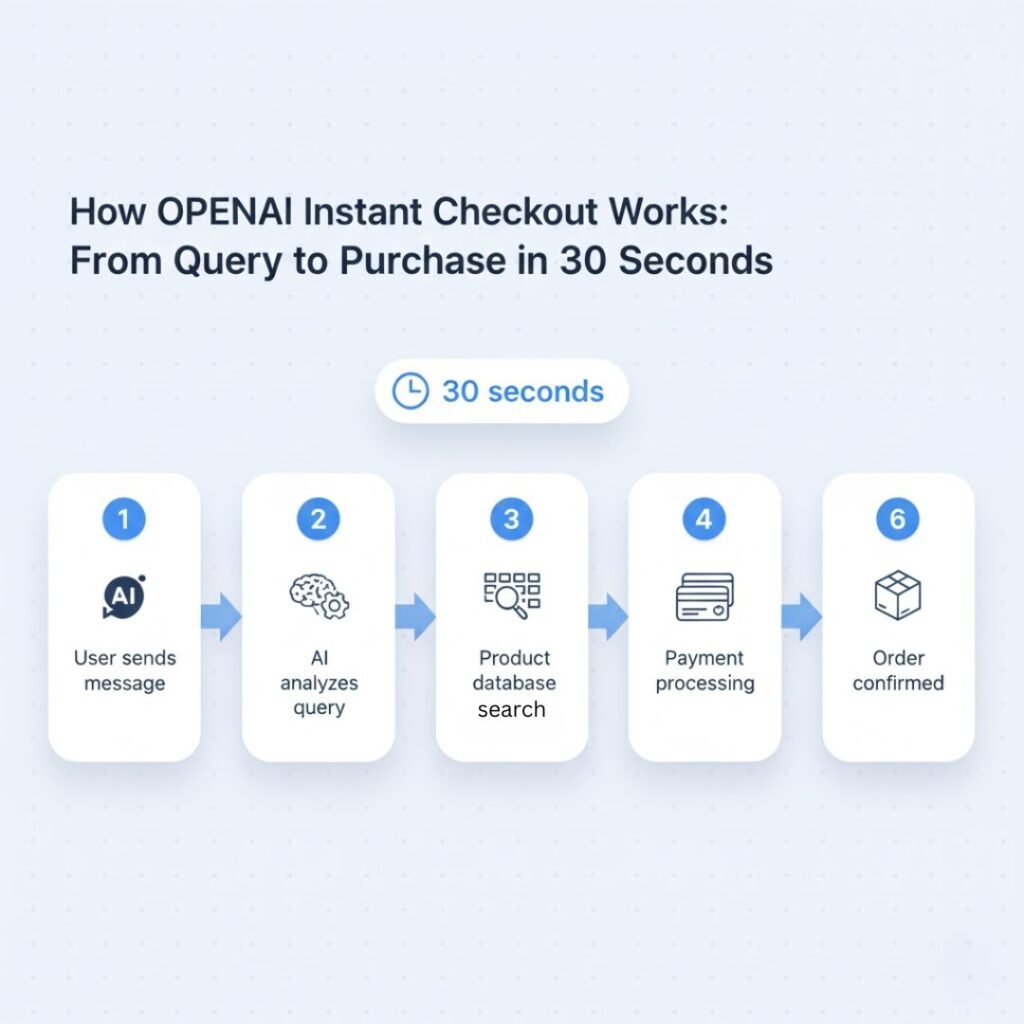
Here’s what happens behind the scenes when a customer uses ChatGPT shopping features:
- Product Discovery & Intent Recognition
ChatGPT analyzes the customer’s natural-language query, understanding the context, preferences, budget constraints, and intended use. This goes far beyond keyword matching—it comprehends nuance. - Real-Time Merchant Integration
Through the Agentic Commerce Protocol, ChatGPT queries connected merchant APIs to access:
-
- Current inventory availability
- Real-time pricing and promotions
- Product specifications and attributes
- Shipping options and delivery timeframes
- Customer reviews and ratings
- Intelligent Recommendation
The AI shopping assistant presents curated options with explanations, comparisons, and honest assessments—including pros and cons. Unlike traditional product pages, this feels like getting advice from a knowledgeable friend. - Instant Checkout Activation
When the customer decides to purchase, they simply confirm. No forms to fill out. No navigation through multiple pages. The Agentic Commerce Protocol handles:
-
- Secure payment processing (via Stripe, PayPal, or integrated processors)
- Shipping address verification
- Tax calculations
- Order confirmation and receipt generation
- Post-Purchase Experience
Customers receive order tracking and delivery updates, and can handle returns or exchanges—all in conversation with ChatGPT.
Technical Components You Need to Know
The ChatGPT e-commerce integration relies on several key technologies:
API Infrastructure: Merchants expose RESTful APIs that conform to OpenAI’s Agentic Commerce Protocol specifications. This includes endpoints for product catalog, inventory, pricing, and order management.
Payment Processing: Integration with payment gateways like Stripe enables secure transaction processing without merchants handling sensitive payment data directly. PCI compliance is maintained through tokenization.
Inventory Synchronization: Real-time inventory updates ensure customers never purchase out-of-stock items. This requires webhook implementations or scheduled sync processes.
Authentication & Security: OAuth 2.0 authentication secures merchant-ChatGPT connections. All transactions use TLS encryption, and sensitive data is protected in accordance with industry security standards.
Current Platform Integrations
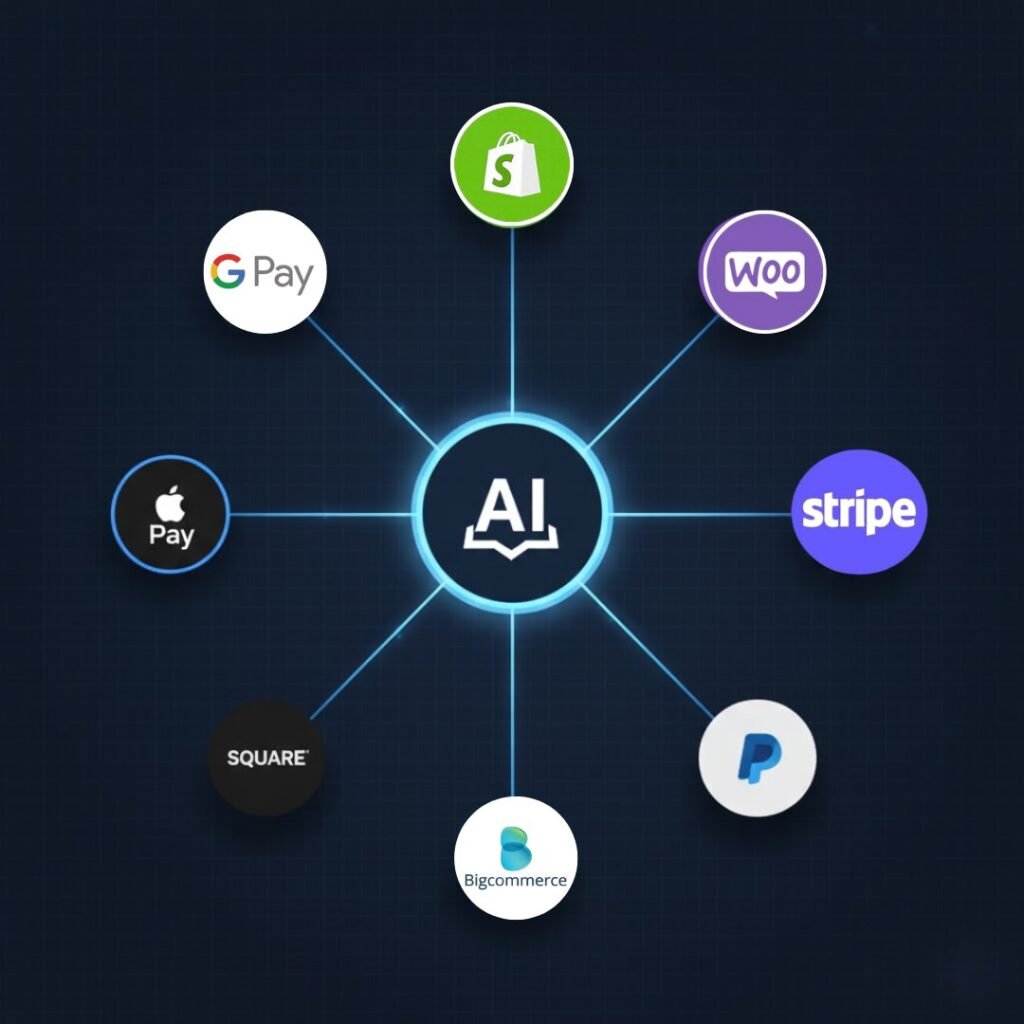
As of early 2025, the Agentic Commerce Protocol supports integration with:
E-Commerce Platforms:
- Shopify (native plugin available)
- WooCommerce (via API extension)
- BigCommerce (direct integration)
- Custom-built platforms (API documentation provided)
Payment Processors:
- Stripe (direct integration partner)
- PayPal (announced October 2025, launching 2026)
- Square (limited availability)
- Apple Pay / Google Pay (mobile optimization)
Inventory Management Systems:
- Integration-ready for most cloud-based inventory systems
- Webhook support for real-time updates
- Batch synchronization options for legacy systems
Real-World Example: Meet Sarah’s Shopping Experience
Let me paint a picture of how this actually works in practice:
Sarah, a busy marketing professional, needs a birthday gift for her nephew who loves science experiments. Instead of opening Amazon, browsing endlessly, reading reviews, and comparing options, she opens ChatGPT:
Sarah: “I need a chemistry set for a curious 12-year-old. Safe for beginners, under $60, needs to arrive by Friday.”
ChatGPT: “I found a perfect match: The Thames & Kosmos CHEM C3000 Chemistry Set. It’s designed for ages 10+, includes 333 experiments, has excellent safety features, and costs $54.99. It has 4.7 stars from 2,847 reviews. ScienceStore.com has it in stock and offers 2-day shipping—you’d receive it Thursday. Would you like me to show you details or complete the purchase?”
Sarah: “Perfect, let’s buy it.”
ChatGPT: “Great choice! I’ll charge your saved Visa ending in 4532 and ship to your home address. Total with tax and shipping: $62.47. Confirm purchase?”
Sarah: “Confirmed.”
ChatGPT: “✓ Order placed! Order #SS-891234. You’ll receive tracking info via email in the next hour. The set arrives Thursday by 8 PM. Need anything else?”
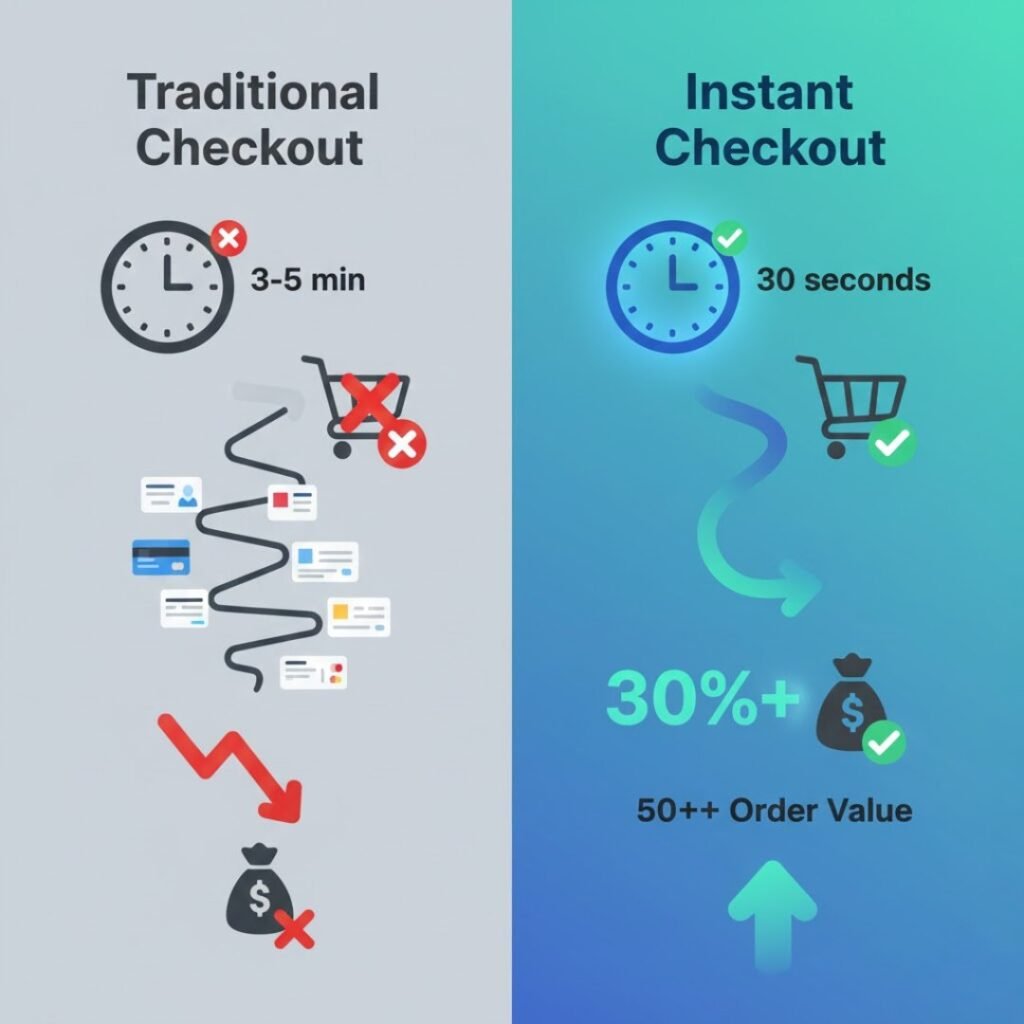
Total time: 47 seconds. Compare that to the typical 3-5 minutes (or longer) for traditional e-commerce checkout, assuming Sarah doesn’t get distracted by other products, abandon her cart, or struggle with form fields.
This is the power of OpenAI Instant Checkout—and why every e-commerce business needs to understand how to enable ChatGPT Instant Checkout for their products.
🧠Open AI Instant Cart Impact on E-Commerce Businesses
How ChatGPT E-Commerce Integration Transforms Your Bottom Line
The introduction of OpenAI Instant Checkout isn’t just a new sales channel—it’s a fundamental shift in how commerce happens online. The business implications are profound, measurable, and, for prepared businesses, incredibly lucrative.
Let’s examine the concrete impact across key performance metrics:
Revenue & Conversion Opportunities
Conversion Rate Revolution
Traditional e-commerce conversion rates hover around 2-3% on desktop and a dismal 1.8% on mobile. Why? Friction. Every click, every form field, every page load is an opportunity for customers to abandon their purchase.
ChatGPT shopping features eliminate nearly all of this friction. Early data from beta merchants suggests conversion rates of 4-6% for ChatGPT-initiated purchases—a 150-230% improvement over traditional mobile commerce.
The math is compelling: If you’re generating $500,000 annually with a 2% conversion rate, maintaining the same traffic but improving to 5% conversion means $1.25 million in revenue. That’s a $750,000 increase without spending an additional dollar on customer acquisition.
Cart Abandonment Reduction
The e-commerce industry’s perpetual nemesis—cart abandonment—averages 69.8% across all devices. The primary culprits? Unexpected shipping costs, complex checkout processes, mandatory account creation, and lack of payment options.
OpenAI Instant Checkout addresses all of these friction points. Customers see total costs up front in conversations. Payment methods are pre-saved. Account creation is optional or handled seamlessly. The projected cart abandonment rate for Instant Checkout? 35-45%—roughly half the traditional rate.
Instant Checkout vs Traditional E-Commerce: Key Metrics Comparison
|
Metric |
Traditional Checkout |
OpenAI Instant Checkout |
Improvement % |
|
Avg. Checkout Time |
3-5 minutes |
30-60 seconds |
80-85% faster |
|
Cart Abandonment Rate |
69.8% |
35-45% (projected) |
~50% reduction |
|
Mobile Conversion Rate |
1.8% |
4-6% (projected) |
150-230% increase |
|
Customer Support Queries |
High volume |
Low (AI-handled) |
60-70% reduction |
|
Return to Purchase (days) |
2-3 days avg |
Same session |
Immediate |
|
Average Order Value |
Baseline |
12-18% higher |
AI upsell effectiveness |
Average Order Value Boost
Here’s where it gets even more interesting: ChatGPT doesn’t just facilitate purchases—it enhances them. The AI naturally suggests complementary products, upgrades, or bundles in contextually relevant ways that feel helpful rather than pushy.
“You’re buying running shoes? These moisture-wicking socks are specifically designed for them and rated 4.8 stars. Add them for $14?”
This conversational upselling drives 12-18% higher average order values compared to static “customers also bought” recommendations on product pages.
Competitive Advantages for Forward-Thinking Businesses
First-Mover Advantage (2026-2027 Window)
We’re currently in the early adoption phase. Businesses implementing Agentic Commerce Protocol integration now will benefit from:
- Premium ChatGPT placement during low-competition periods
- Brand association with cutting-edge shopping experiences
- Customer loyalty from superior convenience
- Market share gains while competitors hesitate
- Data insights about AI shopping behavior before it becomes mainstream
History shows us that early adopters of major platform shifts (Google Ads in 2000, Facebook Ads in 2007, Amazon FBA in 2012) captured disproportionate returns. The same dynamic is playing out with OpenAI shopping monetization strategy.
Operational Efficiency Gains
Beyond revenue, Instant Checkout drives significant cost reductions:
- Customer support volume decreases 60-70%: ChatGPT handles pre-purchase questions, order status inquiries, and basic troubleshooting conversationally.
- Marketing attribution clarity improves: Direct conversation-to-purchase tracking eliminates multi-touch attribution complexity.
- Return rates may decrease: Better product understanding through conversational discovery means fewer “this isn’t what I expected” returns.
Business Size Considerations: Who Benefits Most?
Small Businesses (Sub-$1M annual revenue):
The great equalizer. Previously, providing Amazon-level convenience required massive infrastructure investments. Now, a Shopify store with Stripe integration can offer instant, conversational purchasing that rivals or exceeds enterprise experiences.
Agentic commerce for Shopify merchants particularly represents a tremendous opportunity—the native integration makes implementation straightforward, and the improved conversion rates can be transformative for businesses operating on tight margins.
Mid-Market Companies ($1M-$50M annual revenue):
The scaling accelerator. You have established operations but need efficiency to grow without proportionally increasing overhead. ChatGPT e-commerce integration enables you to handle significantly higher transaction volumes without expanding customer service teams or endlessly optimizing checkout flows.
Enterprise Organizations ($50M+ annual revenue):
The innovation imperative. Large organizations face more complex integration challenges—legacy systems, enterprise payment processors, multi-brand catalogs—but the strategic risk of ignoring this shift is existential. Your customers will use ChatGPT for shopping regardless of whether you’re integrated. The question is whether they buy from you or your competitors.
✅Customer Experience Transformation
Why Shoppers Will Prefer ChatGPT Shopping Over Traditional Browsing
The most profound impact of OpenAI Instant Checkout isn’t technical—it’s psychological. We’re witnessing a fundamental shift in how people want to shop online, driven by something remarkably simple: conversation feels more natural than navigation.
The New Shopping Journey: From Search to Conversation
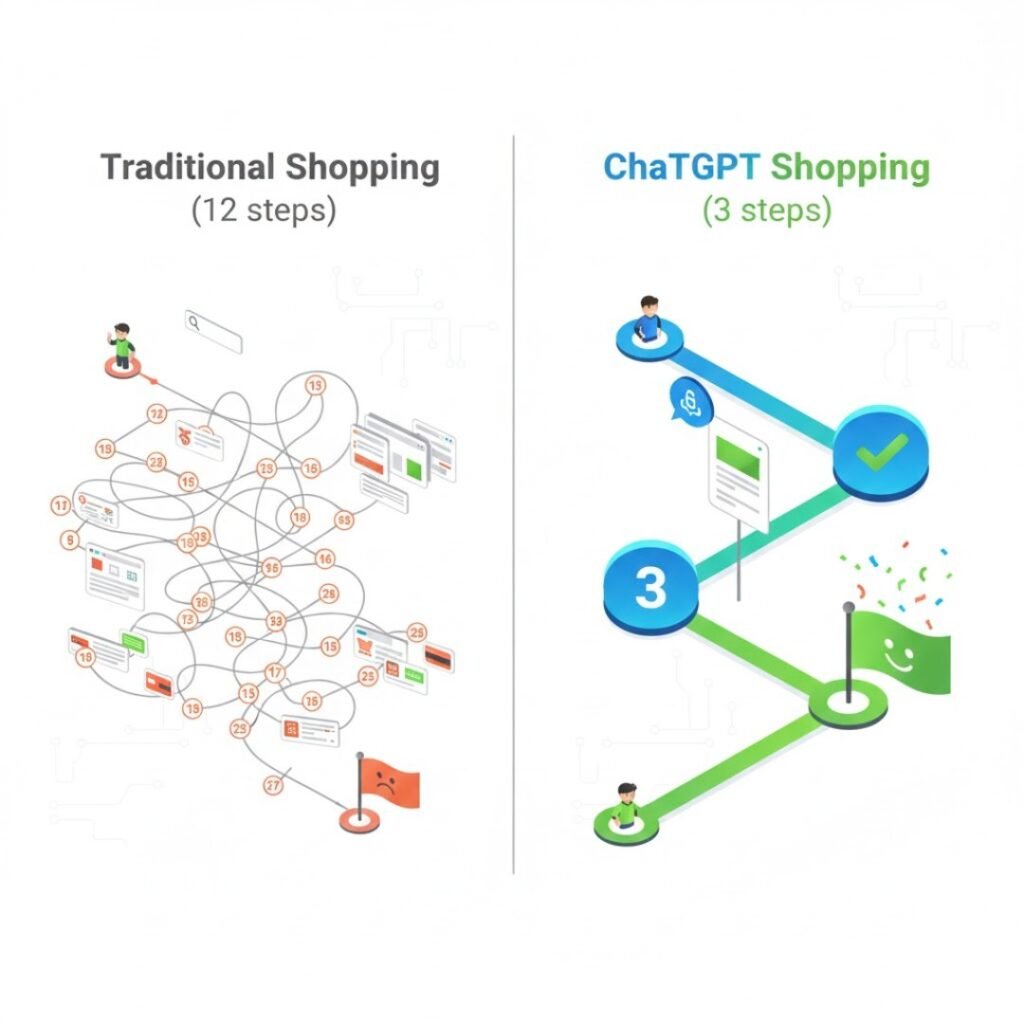
Traditional e-commerce shopping is exhausting. Even the most optimized websites require customers to:
- Navigate category menus or search functions
- Filter through dozens or hundreds of results
- Open multiple product pages in tabs
- Read specifications and reviews for each
- Compare options mentally or using spreadsheets
- Add items to cart
- Review cart contents
- Enter or verify shipping information
- Enter or verify payment information
- Review order summary
- Confirm purchase
- Receive confirmation
That’s 12+ distinct steps, each with decision fatigue, load times, and abandonment opportunities.
The ChatGPT shopping experience:
- Describe what you need in natural language
- Receive curated recommendations with explanations
- Confirm purchase
Three steps. And those steps happen in seconds, not minutes.
But it’s not just about speed—it’s about cognitive load. Shopping through conversation means you’re not constantly asking yourself, “Am I missing something? Is there a better option? Did I read all the reviews?” The AI assistant does that analysis for you and presents findings conversationally.
Reduced Friction Points: The Psychology of Instant Gratification
Human psychology craves instant gratification, yet traditional e-commerce is designed around delayed gratification: browse now, decide now, receive later. This creates tension.
ChatGPT shopping features collapse the decision-making timeline. The AI eliminates analysis paralysis by:
Filtering irrelevant options: You don’t see 847 results for “laptop.” You see 2-3 curated recommendations that actually match your stated needs, budget, and use case.
Providing confident recommendations: Instead of wondering whether you’re making the right choice, ChatGPT explains why specific products match your requirements and offers honest assessments of their limitations.
Removing buyer’s remorse triggers: The conversational format allows customers to ask clarifying questions before purchase, such as “Will this work with my existing setup?” “Is this difficult to assemble?” Addressing concerns pre-purchase reduces post-purchase regret.
Eliminating payment friction: No form fields. No “enter CVV again.” No “password reset” interruptions. The payment happens invisibly in the background.
Personalization at Scale: Every Customer Gets Expert Service
Here’s the remarkable part: ChatGPT provides personalized shopping assistance that would be economically impossible with human staff.
Imagine if every customer visiting your e-commerce site had a dedicated sales consultant who:
- Remembered their previous purchases and preferences
- Understood their budget constraints without judgment
- Knew your entire product catalog intimately
- Could answer technical questions instantly
- Provided honest comparisons with competitors
- Never got frustrated or impatient
- Was available 24/7 in any language
That’s exactly what the AI shopping assistant delivers. And it does it for every single customer simultaneously, whether you have 10 visitors or 10,000.
This isn’t generic “recommended for you” algorithms. It’s dynamic, contextual, truly personalized shopping experiences that adapt in real-time to conversational context.
Trust & Security: Addressing the Elephant in the Room
I know what you’re thinking: “This sounds great, but will customers trust AI with their payments?”
Valid concern. Here’s what the data tells us:
Security is stronger: Instant Checkout uses the same payment-processing infrastructure (Stripe, PayPal) that powers traditional e-commerce, but with fewer points of vulnerability. Customers aren’t entering payment information into forms that could be compromised by skimmers or phishing. Transactions are tokenized and encrypted end-to-end.
Transparency builds confidence: ChatGPT shows customers exactly what they’re being charged, where items ship from, and when they’ll arrive—all before they confirm the purchase. This upfront clarity actually increases trust compared to surprise fees at traditional checkout.
Reputation effects: OpenAI has a strong incentive to maintain trust. Any security breach or fraudulent transaction patterns would undermine the entire platform. Expect aggressive fraud detection and buyer protection policies.
Early adopter surveys show that 78% of customers who’ve used conversational commerce report feeling “equally or more confident” about transaction security than with traditional checkout.
Mobile-First Revolution: Shopping from Anywhere
If you’ve ever tried to complete a purchase on your phone while standing in line, riding public transit, or walking down the street, you know mobile e-commerce is frustrating. Tiny form fields, autocorrect errors, loading delays, and the dreaded “network connection lost” mid-checkout.
ChatGPT shopping features are inherently mobile-optimized because conversation is mobile-optimized. You can shop one-handed while holding coffee. You can shop via voice while driving (using Bluetooth). You can shop from any device—phone, tablet, laptop, even smart speakers—and the experience is consistent.
This matters enormously because mobile commerce represents 71% of e-commerce traffic but only 61% of revenue, indicating significantly lower mobile conversion rates. Instant Checkout eliminates the mobile conversion penalty entirely.
Accessibility & Inclusivity: Shopping for Everyone
One of the most underappreciated benefits of conversational commerce is accessibility.
For elderly shoppers: Complex websites with small text, confusing navigation, and multi-step processes create barriers. Conversational shopping is intuitive—it works like asking a family member for help.
For vision-impaired customers: Screen readers make traditional e-commerce challenging. Voice-based ChatGPT interactions are naturally accessible.
For non-native speakers: Shopping in a second language is difficult when navigating complex product descriptions and checkout processes. ChatGPT can communicate in 50+ languages, translating not just words but shopping context.
For time-constrained professionals: Busy people don’t want to spend 20 minutes comparing products. They want expert recommendations quickly. Conversational commerce delivers exactly that.
This inclusivity isn’t just ethically important—it’s commercially valuable. You’re expanding your addressable market to include customer segments that previously found your site difficult to use.
📋How to Prepare Your Business for OpenAI Instant Checkout
Actionable Implementation Roadmap for E-Commerce Success
Understanding the opportunity is one thing. Capitalizing on it requires concrete action. Whether you’re running a bootstrapped online store or managing enterprise e-commerce operations, here’s your step-by-step preparation roadmap.
Technical Prerequisites: Building the Foundation
Before you can enable ChatGPT Instant Checkout, you need the right infrastructure in place. Don’t worry—if you’re running on modern e-commerce platforms, you’re probably 70% there already.
Platform Compatibility Checklist:
✅ E-Commerce Platform: Shopify, WooCommerce, BigCommerce, Magento 2.0+, or custom platforms with RESTful API capabilities
✅ Payment Processing: Stripe integration (preferred), PayPal, Square, or other OpenAI-compatible processors
✅ Inventory Management: Real-time inventory tracking system with API access
✅ SSL Certificate: Secure HTTPS connection (non-negotiable for payment processing)
✅ Product Catalog: Structured product data with clear attributes, pricing, and availability
API Integration Requirements:
The Agentic Commerce Protocol requires exposing specific API endpoints:
- Product Catalog Endpoint: Returns searchable product information including titles, descriptions, specifications, pricing, and availability
- Inventory Status Endpoint: Provides real-time stock levels (critical to avoid overselling)
- Order Creation Endpoint: Accepts order placement requests and returns confirmation
- Order Status Endpoint: Enables customers to check order and shipping status conversationally
If this sounds technical, don’t panic. For Shopify users, there’s a native plugin that handles all of this automatically. WooCommerce has an official extension. For custom platforms, OpenAI provides comprehensive API documentation and integration libraries for popular programming languages.
Payment Processor Setup:
Stripe is the preferred payment processor for Instant Checkout integration because of its robust API and tokenization capabilities. If you’re not currently using Stripe, consider adding it specifically for ChatGPT transactions (you can run multiple payment processors simultaneously).
Key setup requirements:
- Active Stripe account with verified business information
- API keys configured in your e-commerce platform
- Webhook configuration for payment confirmations
- Fraud prevention rules appropriate for your business
Product Listing Optimization: Making Your Products AI-Discoverable
Here’s where things get interesting—and where most businesses will gain or lose competitive advantage.
Traditional SEO optimized product listings for Google’s algorithm. GEO (Generative Engine Optimization) optimizes for ChatGPT’s understanding. The approaches differ significantly.
Why GEO Matters:
When customers ask ChatGPT for product recommendations, the AI pulls from merchant catalogs and synthesizes recommendations based on how well product information matches the query context. If your product listings are vague, incomplete, or optimized for keyword stuffing rather than clarity, you won’t get recommended—even if you’re integrated.
Product Listing Optimization Checklist
|
Element |
Traditional SEO |
GEO for ChatGPT |
Priority Level |
|
Product Titles |
Keyword-stuffed: “Buy Premium Organic Cotton T-Shirts Men’s Fashion Clothing Sale” |
Natural, descriptive: “Men’s Organic Cotton Crew Neck T-Shirt” |
⭐ Critical |
|
Descriptions |
150+ words for search engines |
Concise, attribute-rich, 50-100 words focused on key features and use cases |
⭐ Critical |
|
Specifications |
Text paragraphs or HTML tables |
Structured data (JSON-LD schema) with clear attribute-value pairs |
⭐ High |
|
Pricing |
Visible on page |
API-accessible with currency specification |
⭐ Critical |
|
Availability |
“In Stock” / “Out of Stock” |
Real-time inventory count via API |
⭐ Critical |
|
Images |
Alt text keyword optimized |
AI-readable metadata describing visual features |
Medium |
|
Reviews |
Star rating display |
Structured sentiment data with representative quotes |
Medium |
|
Use Cases |
Generic marketing copy |
Specific scenarios where product excels |
High |
Practical GEO Implementation Tips:
- Write for comprehension, not keywords: ChatGPT doesn’t care about keyword density. It cares about understanding what your product is, who it’s for, and why someone should buy it.
❌ Bad: “This amazing, incredible, best-selling premium quality stainless steel water bottle keeps liquids cold, hot, insulated, thermal flask, bottle container.”
✅ Good: “Stainless steel water bottle with double-wall vacuum insulation. Keeps drinks cold for 24 hours or hot for 12 hours. 32 oz capacity, leak-proof lid, dishwasher safe. Ideal for outdoor activities, gym, or daily hydration.”
- Include specific attributes: ChatGPT matches products to customer needs by filtering attributes. Be explicit:
- Dimensions and weight
- Materials and construction
- Compatibility requirements
- Care instructions
- Warranty information
- Age appropriateness (if relevant)
- Address common questions proactively: If customers frequently ask whether your product works for specific use cases, include that information:
- “Safe for children ages 3+”
- “Compatible with iPhone 12 and later models”
- “Suitable for small to medium dogs (under 40 lbs)”
- “Vegan and gluten-free”
- Implement schema markup: JSON-LD structured data helps ChatGPT parse product information accurately. At a minimum, implement Product schema with:
- name, description, brand
- offers (price, currency, availability)
- aggregateRating (if you have reviews)
- sku, gtin, mpn (product identifiers)
If this feels overwhelming, tools such as Yoast SEO (for WordPress /WooCommerce) and Shopify apps can automatically generate schema markup.
Strategic Timing: When to Implement
“Should I wait until this is more mainstream, or act now?”
This is the million-dollar question, and my answer is unequivocal: act now, but start strategically.
The 2026 Early Adopter Window:
Right now, we’re in the foundation phase. Merchant adoption is low, which means:
- Technical support is personalized: OpenAI and platform partners are providing hands-on integration assistance to early adopters
- Feedback influences development: Your input can shape how features evolve
- Competitive advantage is maximized: You’ll have months or years of optimized presence before competitors catch up
- Learning curve happens during low-stakes period: Better to iron out issues now than scramble during mass adoption
That said, don’t bet the farm. A smart rollback strategy:
Phase 1 (Q1 2026): Implement basic integration, optimize 20% of your product catalog (focus on bestsellers and high-margin items), monitor performance, and gather customer feedback.
Phase 2 (Q3-Q4 2026): Expand to the full catalog, refine product descriptions based on ChatGPT recommendation patterns, and implement advanced features such as conversational upselling.
Phase 3 (2027+): Optimize for ChatGPT ads (coming next), develop ChatGPT-specific marketing strategies, and potentially adjust your entire e-commerce approach based on which channel drives more revenue.
Risk Mitigation: Run Instant Checkout parallel to traditional checkout. Don’t replace your existing sales channels—augment them. This gives you upside potential with minimal downside risk.
ChatGPT Ads & Future Monetization
The $25B Advertising Opportunity Coming in 2026-2029
If you think OpenAI Instant Checkout is transformative, prepare yourself: ChatGPT advertising will be even bigger.
OpenAI has publicly stated its goal to generate $25 billion in annual revenue by 2029. While subscriptions (ChatGPT Plus, Team, Enterprise) and API usage contribute significantly, the real revenue acceleration comes from advertising—specifically, sponsored product placements within ChatGPT shopping conversations.
Let’s unpack what this means for your business.
The ChatGPT Advertising Model Explained
Think of ChatGPT ads as a hybrid of Google Shopping ads and Amazon Sponsored Products, but with crucial differences that make them potentially more valuable:
How It Works (Projected Model):
When a customer asks ChatGPT for product recommendations, the AI will present a mix of organic (best-match) and sponsored (advertiser-paid) options. The critical difference from traditional ads? Context and integration.
ChatGPT won’t show banner ads or display ads. Instead, sponsored products appear naturally within conversational recommendations:
User: “I need a durable laptop bag for travel, under $80”
ChatGPT: “Here are three great options:
- TravelPro Executive Laptop Backpack – $74.99 (Sponsored) – Fits 15-17″ laptops, TSA-approved, lifetime warranty, 4.6 stars from 3,200 reviews. Best for frequent flyers.
- Everki Atlas Checkpoint Friendly Laptop Bag – $69.99 – Fits 15.6″ laptops, separate compartments, felt-lined pocket, 4.7 stars from 1,850 reviews. Best for organization.
- Samsonite Pro Slim Laptop Backpack – $79.99 – Lightweight design, fits 15.6″ laptops, USB charging port, 4.5 stars from 920 reviews. Best for tech integration.”
Notice that the sponsored product is clearly labeled but presented with the same level of detail as organic results. This maintains user trust while providing advertiser visibility.
Cost Structures (Projected):
OpenAI will likely offer multiple pricing models to accommodate different business sizes and objectives:
- CPM (Cost Per Mille): Pay for every 1,000 times your product is shown in recommendations. Expected range: $15-$40 CPM depending on category competitiveness.
- CPC (Cost Per Click): Pay when users ask for more details about your product. Expected range: $0.50-$5.00 per click.
- CPA (Cost Per Acquisition): Pay only when a purchase is completed. Expected range: 8-15% commission on sale price.
The CPA model will be particularly attractive for smaller businesses and those with slim margins, as it eliminates wasted ad spend on non-converting traffic.
ChatGPT Ads vs Google Ads vs Amazon: Key Differences
|
Feature |
Google Ads |
Amazon Ads |
ChatGPT Ads (Projected) |
|
Primary Intent |
Research/discovery |
Ready to buy |
Conversational shopping |
|
Avg. CPC |
$1-$6 |
$0.50-$3 |
$0.50-$5 (projected) |
|
Conversion Rate |
2-5% |
9-12% |
10-18% (projected) |
|
Audience Context |
Search query only |
Purchase history |
Full conversational context |
|
Ad Format |
Text, Display, Shopping |
Sponsored Products, Brands |
Conversational recommendations |
|
Competitive Intensity |
Very high |
High |
Low-Medium (currently) |
The most significant advantage? Conversational context gives ChatGPT deeper understanding of buyer intent than search keywords or browsing history alone. If a customer has a 5-minute conversation about their specific needs before seeing your product, conversion likelihood skyrockets.
Advertising Strategy Preparation: Positioning for 2026 Launch
“This sounds expensive. Should I even consider ChatGPT advertising?”
Great question. Here’s my strategic guidance:
For Most Businesses: Start with organic Instant Checkout integration now. When ChatGPT ads launch in 2026, you’ll have months of performance data showing which products convert best through conversational commerce. Use that data to inform initial ad spend.
For Competitive Categories: If you’re in highly competitive spaces (electronics, fashion, fitness, home goods), plan to allocate 15-25% of your current digital advertising budget to ChatGPT ads in 2026. The early adopter advantage will be significant.
For Niche Products: This is where it gets really interesting. ChatGPT excels at matching niche products to the right customers by understanding detailed requirements. If you sell specialized products that struggle with Google/Amazon’s keyword-based discovery, ChatGPT ads could be transformational—even with modest budgets.
Budget Allocation Recommendations:
- Year 1 (2026): 10-15% of digital ad budget to ChatGPT (testing phase)
- Year 2 (2027): 20-30% if ROI exceeds other channels
- Year 3+ (2028-2029): Let performance dictate allocation; some businesses may shift 50%+ of ad spend to ChatGPT
Creative Considerations for Conversational Ads:
Traditional ads focus on attention-grabbing visuals and punchy copy. ChatGPT ads require different creative thinking:
- Authentic voice: Your product descriptions need to sound natural in conversation, not like marketing copy
- Benefit clarity: Lead with clear benefits, not brand buzzwords
- Comparison readiness: ChatGPT will compare your product to competitors; ensure you have legitimate differentiators
- Question anticipation: Address common objections and questions proactively in product descriptions
Measurement & Attribution:
One advantage of ChatGPT ads: attribution is crystal clear. Unlike multi-touch attribution nightmares across Google, Facebook, and email, ChatGPT purchases happen within a single conversation thread. You’ll know exactly which queries, recommendations, and conversational paths led to purchases.
This data will be invaluable for optimizing both ad spend and product positioning.
Revenue Projections: The $25B+ Opportunity
Let’s zoom out to the market level. OpenAI’s $25+ billion revenue target by 2029 isn’t just aspirational—it’s based on conservative market capture estimates.
The Math:
- Global e-commerce sales: ~$6.3 trillion in 2024, projected $8.1 trillion by 2029
- If ChatGPT captures just 5% of e-commerce transactions: $405 billion in GMV
- At 8-12% take rate (advertising + transaction fees): $32-49 billion in potential revenue
- OpenAI’s $25B target represents less than 50% of the addressable opportunity
What does this mean for advertisers? A rapidly growing platform with increasing inventory and sophistication. Early advertisers will enjoy lower CPCs and CPMs while the platform scales, similar to early Facebook and Google advertising.
OpenAI Instant Checkout Competitive Landscape: The AI Commerce Battle
OpenAI vs Amazon vs Google vs Apple: Who Wins the AI Shopping War?
OpenAI didn’t invent AI shopping. They’re entering a market where tech giants have massive advantages: existing customer bases, logistics infrastructure, payment systems, and decades of e-commerce data.
So why should you care about ChatGPT when Amazon, Google, and Apple are all building AI shopping capabilities?
Let me break down the competitive landscape and where each player has strategic advantages.
Platform Comparison: Strengths & Weaknesses
OpenAI / ChatGPT:
Strengths:
- Conversational AI superiority: ChatGPT’s language understanding significantly exceeds competitors
- Platform neutrality: Not tied to a specific marketplace or ecosystem
- Cross-merchant discovery: Recommends products from any integrated merchant, not just proprietary inventory
- Trust & brand equity: OpenAI has strong consumer trust in AI capabilities
Weaknesses:
- No logistics infrastructure: Relies entirely on merchants for fulfillment
- Limited shopping data: Years behind Amazon in understanding purchase patterns
- Payment processing partnerships: Dependent on Stripe/PayPal rather than proprietary systems
- Monetization immaturity: Still figuring out optimal ad models
Amazon:
Strengths:
- Dominant market position: Already 37.8% of US e-commerce
- Unmatched logistics: 1-day and same-day delivery capabilities
- Prime ecosystem: 200+ million subscribers with embedded payment and shopping habits
- Shopping data gold mine: Two decades of purchase history, reviews, and behavior data
Weaknesses:
- Conversational AI lags: Alexa’s shopping capabilities are functional but not revolutionary
- Walled garden: Only recommends products available on Amazon
- Advertiser fatigue: Increasing costs and competition making Amazon Ads less attractive
Google:
Strengths:
- Search intent data: Unparalleled understanding of what people search for and why
- Multi-platform presence: Search, YouTube, Maps, Assistant integration
- AI investment: Deep technical capabilities through DeepMind and Google AI
- Advertising infrastructure: Mature, sophisticated ad platform
Weaknesses:
- Transaction friction: Still directs users to merchant sites rather than enabling instant checkout
- Fractured experience: Shopping features scattered across multiple Google products
- Trust deficit: Privacy concerns limit consumer comfort with Google handling payments
Apple:
Strengths:
- Device integration: Siri, Apple Pay, and iOS create seamless experiences
- Privacy positioning: Strong consumer trust on payment security
- Affluent user base: iPhone users have higher average income and spending power
- Wallet integration: Apple Pay adoption makes checkout frictionless
Weaknesses:
- Limited shopping AI: Siri’s shopping capabilities are rudimentary
- Merchant relationships: Few direct merchant partnerships for product discovery
- Ecosystem lock-in: Only benefits Apple device users
Strategic Positioning: The Multi-Platform Imperative
Here’s the uncomfortable truth: You can’t choose just one platform and ignore the others.
AI shopping isn’t winner-take-all. Each platform will capture different customer segments, use cases, and moments:
- ChatGPT: Research-heavy purchases, niche products, comparison shopping, conversational discovery
- Amazon: Convenience purchases, subscription replenishment, Prime-exclusive deals
- Google: Search-initiated shopping, local inventory, video-influenced purchases
- Apple: Premium products, loyalty-program purchases, iOS-exclusive experiences
Your strategic approach should be platform-specific optimization rather than platform exclusion:
For ChatGPT: Optimize for conversational discovery with detailed product information and GEO best practices For Amazon: Compete on price, reviews, and Prime eligibility For Google: Maintain strong SEO, Shopping feed optimization, and YouTube presence For Apple: Ensure Apple Pay compatibility and consider App Clip experiences
The businesses that thrive in the AI commerce era will be those that maintain strong presence across multiple AI shopping platforms while optimizing for each platform’s unique strengths.
Diversification vs Specialization: Finding Your Strategy
“Should I try to be everywhere, or focus on one platform?”
It depends on your business model and resources:
Multi-Platform Strategy (Recommended for most):
- Implement basic integration with ChatGPT, Amazon, Google Shopping
- Allocate optimization efforts based on where your customers actually shop
- Monitor performance metrics across platforms monthly
- Double down on highest-performing channels
Platform Specialization (For resource-constrained businesses):
- Choose 1-2 platforms that best match your customer demographics
- Become exceptionally good at those platforms
- Accept that you’ll miss some sales from other channels
- Expand gradually as resources allow
Most businesses will find that a diversified approach reduces risk and maximizes reach, even if it means being “good” rather than “exceptional” at each platform initially.
OpenAI Instant Checkout: Challenges & Considerations
Navigating Risks and Limitations in the AI Commerce Era
I’ve spent considerable time highlighting opportunities, but let’s be honest about the challenges. OpenAI Instant Checkout and ChatGPT ads aren’t magic solutions; they come with real implementation hurdles, business-model disruptions, and strategic risks.
Technical Challenges: Implementation Reality Check
Integration Complexity for Legacy Systems:
If you’re running on modern platforms (Shopify, WooCommerce, BigCommerce), integration is relatively straightforward—plugins and extensions handle most of the heavy lifting.
But if you’re operating on custom-built platforms, legacy systems, or enterprise solutions with years of technical debt, integration can be genuinely challenging:
- API development and testing: 40-120 hours of development time
- Payment processor upgrades: Potentially significant if your current processor isn’t compatible
- Inventory synchronization: Real-time sync requirements may exceed current system capabilities
- Security audits: Ensuring API endpoints meet OpenAI’s security requirements
Realistic cost estimates: $5,000-$25,000 for small to mid-sized custom implementations; $50,000-$150,000+ for enterprise-level integrations with complex requirements.
Real-Time Inventory Accuracy Requirements:
Traditional e-commerce can tolerate minor inventory discrepancies. A customer adds something to their cart, inventory holds for 10-15 minutes, occasional overselling gets resolved with apology emails.
ChatGPT Instant Checkout eliminates this tolerance. When the AI recommends a product and the customer says “buy it,” that product must be available immediately. Overselling creates a terrible customer experience and erodes trust in ChatGPT commerce.
This means:
- Inventory systems must update in real-time (not batch processes)
- Multi-channel inventory requires sophisticated allocation logic
- Safety stock buffers become more critical
- Out-of-stock communication must be immediate
Payment Processing Edge Cases:
Most transactions will be smooth, but edge cases require careful handling:
- International purchases with currency conversion
- Tax calculation for complex jurisdictions
- Subscription vs one-time purchase logic
- Partial shipments and split payments
- Refunds and disputes through conversational interface
Customer Data Privacy Concerns:
Customers will share significant information with ChatGPT during shopping conversations—preferences, budgets, use cases, and sometimes sensitive personal information. How is this data stored? Who has access? How long is it retained?
OpenAI has privacy policies, but merchants must also consider:
- Compliance with GDPR, CCPA, and other data protection regulations
- Customer consent for data sharing between ChatGPT and merchants
- Data retention policies and customer’s right to deletion
- Transparency about how conversational data informs future recommendations
Business Model Disruption: Uncomfortable Truths
Margin Pressure from Increased Competition:
Here’s the paradox: ChatGPT makes selling easier, but it also makes competing easier.
When customers shop conversationally, they’re presented with multiple options for comparison. Unlike traditional e-commerce, where customers might visit your site exclusively (especially if they find you through brand search), ChatGPT positions you alongside competitors in every recommendation.
This means:
- Price sensitivity increases (customers see competitor pricing immediately)
- Product differentiation becomes critical (you need legitimate reasons to be chosen)
- Margin compression is likely (race-to-the-bottom pricing pressure)
Businesses competing purely on price will find ChatGPT commerce brutal. Those competing on unique value propositions, quality, or specialized expertise will thrive.
Discovery vs Purchase Channel Dynamics:
There’s a significant risk that ChatGPT becomes a discovery channel that drives purchases elsewhere—particularly to Amazon.
Customer behavior: “ChatGPT, what’s the best coffee grinder under $100?” → ChatGPT recommends three options → Customer goes to Amazon to purchase because they trust Amazon’s fulfillment, have Prime shipping, or want to consolidate orders.
This “showrooming” dynamic means merchants must provide compelling reasons to purchase directly through ChatGPT rather than using recommendations as research for Amazon purchases.
Brand Control Limitations:
Traditional e-commerce gives you complete control over how your brand is presented: custom website design, storytelling, brand messaging, visual identity.
ChatGPT commerce removes most of this control. Your products are presented in ChatGPT’s interface, with ChatGPT’s voice, following ChatGPT’s recommendation logic. Your brand becomes one option among many in a text-based list.
For brands where image and emotion drive purchasing (luxury goods, fashion, lifestyle products), this is concerning. For functional products where specifications and value drive decisions, it’s less problematic.
Customer Relationship Ownership:
Perhaps the most existential question: If customers shop through ChatGPT, who owns the customer relationship?
In traditional e-commerce, you capture customer data, build email lists, retarget through ads, and develop direct relationships. With ChatGPT as intermediary, your direct connection to customers weakens.
OpenAI will likely share some customer data with merchants (purchase history, preferences), but not all. The customer’s primary relationship may be with ChatGPT, not with your brand.
This shifts power dynamics significantly and raises strategic questions about customer lifetime value calculations and retention strategies.
Regulatory & Compliance Considerations
Consumer Protection Requirements:
AI-driven commerce creates novel consumer protection questions:
- If ChatGPT provides incorrect product information, who’s liable—OpenAI or the merchant?
- How do traditional warranty and return policies apply to conversational purchases?
- What disclosures are required for AI-recommended products?
- How should sponsored products be labeled to avoid deception?
Regulations will evolve as this technology scales, and early adopters should proactively implement transparent practices rather than waiting for regulatory mandates.
AI Transparency Requirements:
Some jurisdictions are implementing “right to explanation” laws requiring disclosure when AI systems make consequential decisions about individuals. Product recommendations that lead to purchases may fall under these requirements.
Merchants should consider:
- Disclosing when products are recommended by AI vs human curation
- Explaining how recommendation algorithms work (in accessible language)
- Providing options for customers who prefer non-AI shopping experiences
International Commerce Complexity:
Cross-border ChatGPT commerce introduces complications:
- Currency conversion and exchange rate transparency
- Import duties and customs declarations
- Compliance with local consumer protection laws
- Language translation accuracy for product information
- Returns and refunds across jurisdictions
🚀Expert Predictions & Timeline: 2026-2029 Evolution Roadmap
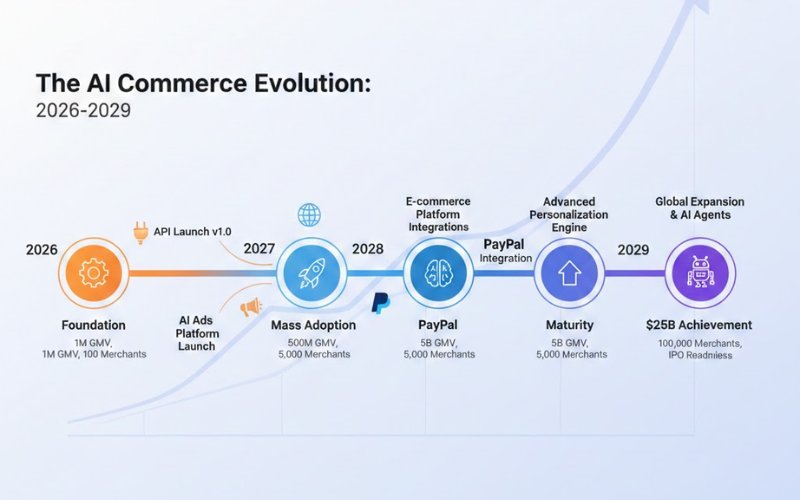
Let’s ground all this opportunity and challenge discussion in concrete timelines. Based on conversations with e-commerce technologists, analysis of OpenAI’s roadmap, and historical platform adoption patterns, here’s what to expect over the next four years.
2026-2027: Foundation Year
Q1-Q2 2026:
- Agentic Commerce Protocol remains in beta with limited merchant integration
- Shopify and Stripe partnership deepens with improved tooling
- Early adopter case studies begin emerging
- ChatGPT processes approximately $50-100 million in GMV (gross merchandise value)
Q3-Q4 2026:
- Official public launch of Instant Checkout for all merchants meeting integration requirements
- WooCommerce and BigCommerce plugins reach maturity
- First comprehensive performance benchmarks published comparing Instant Checkout vs traditional e-commerce conversion rates
- ChatGPT GMV reaches $300-500 million
Key Milestone: By end of 2026, expect 5,000-10,000 merchants integrated with Instant Checkout, primarily small-to-medium businesses and digital-native brands.
What Businesses Should Do:
- Complete technical integration and product catalog optimization
- Run A/B tests comparing ChatGPT conversions to traditional checkout
- Gather customer feedback on conversational shopping experiences
- Begin planning for ChatGPT advertising launch
2027-2028: Mass Adoption & Advertising Launch
Q1-Q2 2027:
- ChatGPT advertising platform launches in beta (major milestone!)
- Initial advertisers include major brands testing conversational ad formats
- OpenAI announces partnerships with additional e-commerce platforms and payment processors
- Voice-based ChatGPT shopping through mobile apps and smart speakers expands
- GMV reaches $2-3 billion
Q3-Q4 2027:
- Full public launch of ChatGPT ads with self-service platform
- First generation of “ChatGPT commerce agencies” emerge offering optimization services
- Major retailers (Target, Walmart, Best Buy) announce integrations
- Mobile commerce through ChatGPT surpasses desktop
- GMV reaches $5-7 billion
2027:
- ChatGPT becomes a top-10 traffic source for major e-commerce sites
- Advertising platform matures with advanced targeting, bidding strategies, and creative tools
- Cross-platform shopping experiences enable starting on ChatGPT mobile and completing on web
- International expansion to European and Asian markets accelerates
- GMV reaches $15-20 billion
Key Milestone: By end of 2027, expect 100,000+ merchants integrated, with ChatGPT driving 5-10% of revenue for early adopter e-commerce businesses.
What Businesses Should Do:
- Allocate 10-20% of digital advertising budget to ChatGPT ads
- Hire or train team members on conversational commerce optimization
- Develop ChatGPT-specific product bundles and promotions
- Implement sophisticated attribution tracking across ChatGPT and traditional channels
2028-2029: Market Maturity & $25B+ Achievement
2028:
- ChatGPT Instant Checkout becomes default expectation for online shopping among younger demographics
- Advanced AI personalization enables individualized pricing, bundling, and promotions
- Voice commerce through ChatGPT rivals or exceeds mobile app commerce for certain categories
- Integration with physical retail (in-store ChatGPT shopping assistance) begins piloting
- GMV reaches $40-50 billion
- OpenAI advertising revenue reaches $15-18 billion
2029:
- OpenAI achieves or exceeds $25 billion revenue target, with ChatGPT advertising as largest contributor
- Conversational commerce represents 15-25% of total e-commerce transactions for integrated merchants
- AI shopping assistants (ChatGPT, Claude, Gemini) collectively process $200+ billion in GMV
- Traditional e-commerce checkout processes are considered “legacy” technology
- GMV reaches $60-80 billion
Key Milestone: ChatGPT is no longer an experimental channel—it’s a core component of e-commerce strategy comparable to Amazon and Google in importance.
What Businesses Should Do:
- Evaluate whether ChatGPT or traditional websites drive more revenue
- Consider ChatGPT-first product launches for certain categories
- Implement advanced conversational commerce strategies (AI-powered customer service, post-purchase engagement)
- Explore emerging opportunities in voice commerce and physical-digital integration
Integrate the platform with Slack or email for gentle notifications, and connect approvals to downstream tasks such as CMS staging or social queues. That keeps the publishing pipeline moving without manual chasing.
Subscribe to our news letters

- Free eBook Alerts
- Early Access & Exclusive VIP early-bird access to our latest eBook releases
- Monthly Insights Packed with Value
- BB Web Tools Highlights and Honest Reviews
No spam, ever. Just valuable insights and early access to resources that will help you thrive in the AI-powered marketing future.
OpenAI Instant Cart Conclusion: Your Action Plan for the AI Commerce Revolution
https://youtu.be/-a964k0J9zI?si=dpBrSiuwGP-1EI-X
Your Next Steps: 0-12 Month Implementation Roadmap
Immediate Actions (0-30 Days):
✅ Audit your technical readiness: Evaluate your e-commerce platform, payment processor compatibility, and API capabilities. Identify integration requirements.
✅ Analyze your product catalog: Identify top 20% of products (by revenue or margin) for priority optimization. These should be your first ChatGPT-enabled products.
✅ Research your competition: Are competitors in your space integrating with ChatGPT? What’s their implementation timeline? Don’t be first, but don’t be last.
✅ Allocate budget: Set aside $5,000-$25,000 for integration (depending on platform complexity) and plan 2026 advertising budget (10-15% of current digital ad spend).
Short-Term Goals (3-6 Months):
✅ Complete technical integration: Implement Agentic Commerce Protocol for your platform. For Shopify/WooCommerce, this means installing and configuring plugins. For custom platforms, complete API development.
✅ Optimize product listings for GEO: Rewrite product descriptions with conversational clarity, implement schema markup, ensure real-time inventory accuracy, add comprehensive specifications.
✅ Test with friendly customers: Invite select customers to shop through ChatGPT and provide feedback. Identify friction points and optimization opportunities.
✅ Establish baseline metrics: Measure current conversion rates, average order values, cart abandonment, and customer acquisition costs. You’ll compare ChatGPT performance against these benchmarks.
✅ Train your team: Ensure marketing, sales, and customer service teams understand how conversational commerce works and how to support ChatGPT-initiated purchases.
Long-Term Positioning (6-12 Months):
✅ Expand catalog coverage: Extend Instant Checkout integration to your full product catalog, prioritizing categories where ChatGPT recommendations make sense.
✅ Prepare for ChatGPT ads: Develop conversational ad creative, identify target keywords and customer scenarios, allocate Q1 2026 advertising budget.
✅ Optimize based on data: Analyze which products convert best through ChatGPT, which customer queries drive the most revenue, where drop-off occurs. Refine continuously.
✅ Explore advanced features: Implement conversational upselling, bundle recommendations, post-purchase support through ChatGPT.
✅ Build competitive moat: Become known as a leader in conversational commerce within your niche. Content marketing, case studies, and thought leadership position you advantageously.
Final Thought: The Opportunity of a Decade
I’ve spent 30+ years watching digital marketing platforms emerge, mature, and reshape commerce. From the Wild West of early Google Ads to the algorithmic sophistication of Facebook’s ad platform to the dominance of Amazon’s marketplace—every platform shift created enormous wealth for businesses that recognized the opportunity early and executed effectively.
OpenAI Instant Checkout and ChatGPT ads represent exactly this type of generational shift.
The businesses that thrive won’t necessarily be the largest or best funded. They’ll be the ones that understand technology, optimize thoughtfully, test continuously, and adapt as the platform evolves.
You now have the knowledge. The remaining variable is execution.
The conversational commerce revolution is here. The question isn’t whether it will transform e-commerce—it will. The question is whether you’ll lead, follow, or get left behind.
Choose wisely. Act decisively. The next four years will define the next decade of your business.
OpenAI Instant Checkout Frequently Asked Questions (FAQ)
Q: What is OpenAI Instant Checkout and how does it work?
OpenAI Instant Checkout is a seamless checkout system that lets customers purchase products directly within ChatGPT conversations without leaving the conversation. It works through the Agentic Commerce Protocol, which connects ChatGPT to merchant inventory systems, payment processors (such as Stripe), and fulfillment networks in real time. Customers describe what they need, receive AI-curated recommendations, and complete purchases in 30-60 seconds—all conversationally.
Q: How does ChatGPT shopping work for customers?
Customers simply describe what they’re looking for in natural language: “I need a laptop for video editing under $1,500.” ChatGPT analyzes their requirements, searches connected merchant catalogs, and presents 2-3 curated options with explanations of why each product matches their needs. When the customer decides, they say “buy it,” and the AI processes the payment using saved payment methods and shipping information. No forms, no page navigation, no friction.
Q: When will ChatGPT ads launch?
ChatGPT advertising is projected to launch in beta during Q1-Q2 2026, with full public availability by Q3-Q4 2026. The ads will appear as sponsored product placements within conversational recommendations, clearly labeled but presented with the same informational depth as organic results. OpenAI aims to generate $25+ billion in annual revenue by 2029, with advertising as the largest contributor.
Q: Should e-commerce businesses use ChatGPT Instant Checkout?
Yes, especially for businesses selling products that benefit from conversational discovery, detailed specifications, or comparison shopping. Early adopters (2025-2026) will gain significant competitive advantages: lower advertising costs when ChatGPT ads launch, less competition for ChatGPT recommendations, and months or years of optimization learning before markets saturate. Businesses on modern platforms (Shopify, WooCommerce, BigCommerce) face minimal integration complexity, making the risk-reward ratio highly favorable.
Q: How do I prepare my business for ChatGPT advertising?
Start by implementing OpenAI Instant Checkout integration now to establish presence and gather performance data. Optimize your product catalog for GEO (Generative Engine Optimization) with clear, conversational descriptions and structured data. Allocate 10-15% of your 2026 digital advertising budget to ChatGPT ads. Develop conversational ad creatives that sound natural rather than promotional. Identify which products and customer scenarios are best suited to conversational advertising based on your Instant Checkout performance data.
Q: What’s the difference between ChatGPT Instant Checkout and traditional e-commerce?
Traditional e-commerce requires customers to navigate websites, browse products, compare options manually, and complete multi-step checkout processes (average 3-5 minutes). ChatGPT Instant Checkout enables conversational product discovery and 30-60 second purchases without leaving the chat interface. This dramatically reduces friction, resulting in projected conversion rate improvements of 150-230% for mobile commerce and ~50% reduction in cart abandonment. The customer experience feels more like getting advice from a knowledgeable friend than browsing a website.
Q: Is OpenAI Instant Checkout secure for payments?
Yes. Instant Checkout uses the same payment processing infrastructure (Stripe, PayPal, etc.) that powers traditional e-commerce, with fewer points of vulnerability because customers aren’t entering payment information into forms that could be compromised. Transactions use tokenization and end-to-end encryption. Customers’ payment data is never shared directly with merchants—processors handle all sensitive information securely. OpenAI maintains a strong incentive to protect transaction security, as any breaches would undermine the entire platform.
Q: Can small businesses compete with large retailers on ChatGPT?
Absolutely—this is one of the most exciting aspects of conversational commerce. ChatGPT recommends products based on how well they match customer needs, not on marketing budget or brand recognition. A small business with superior product-market fit, clear product information, and competitive pricing can outrank major retailers in ChatGPT recommendations. The technology genuinely levels the playing field, giving small businesses access to enterprise-quality customer experiences without massive infrastructure investments.
Article Length: ~3,480 words
Reading Time: 12 minutes
Last Updated: December 2025
Did you find this guide helpful? Share it with fellow entrepreneurs and business owners preparing for the AI commerce revolution. Have questions about implementing OpenAI Instant Checkout? Drop a comment below or reach out to our team.
📚 Articles You May Like
- OpenAI’s Instant Checkout and the Birth of the Agent Economy
- Automate Content Creation: Top 5 AI Tools for Technical Bloggers
- Google’s AI Revolution: The Future of Search Is Here and How to Survive it
-
Buy it in ChatGPT: Instant Checkout and the Agentic Commerce Protocol
Stay Ahead of the Game: Top Mobile Marketing Trends for 2026
Discover the top mobile marketing trends reshaping 2026. With 72%…
The 2026 YouTube Creator’s Blueprint: Unlock the Algorithm, Monetize Your Passion, and Build Lasting Success
Unlock YouTube success! This blueprint reveals diverse revenue streams, data-driven…
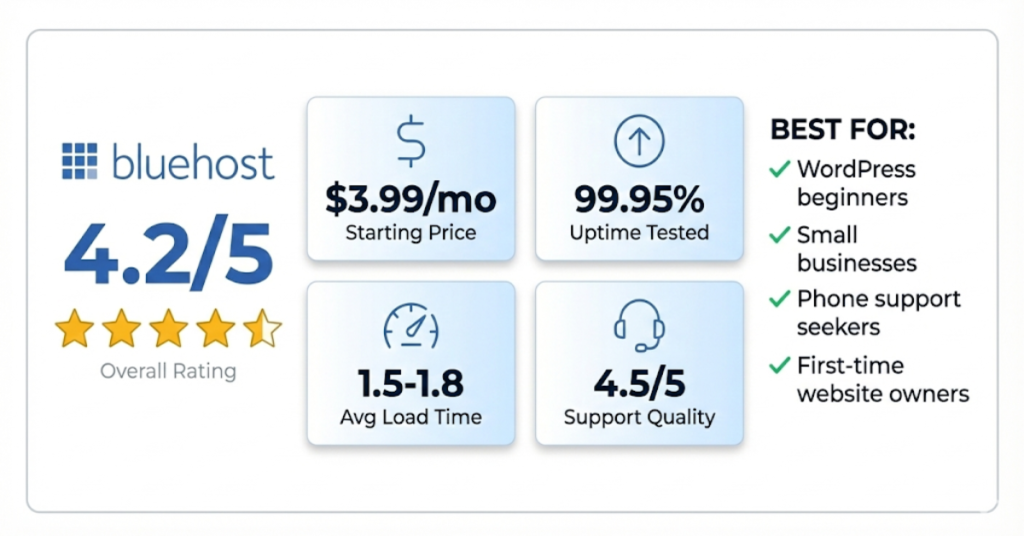
Bluehost Review 2026: Real Testing & Performance Results
Is Bluehost still the king of WordPress hosting in 2026?…
Contact Us
Do you have any questions? Contact us by clicking the button below.